
Selling an Infill Lot in Edmonton
How owners can prepare useful site information for developers and builders.
Read the guide ↗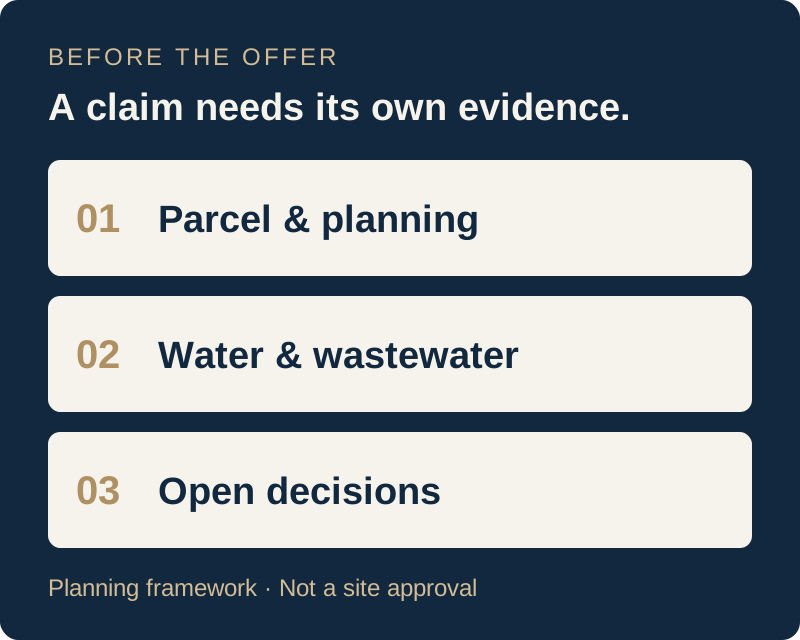
Compare Edmonton infill and regional acreages through parcel records, development stages, access, water, wastewater and an evidence-based offer checklist. This guide is intended as general background—not a substitute for property-specific financial, legal, municipal or professional advice.
An Edmonton infill lot and an acreage marketed near Pigeon Lake may both be described as development opportunities, but they need different investigations. Write down the legal parcel, responsible municipality, existing improvements and intended use before comparing asking prices. A community name, postal address or map pin does not establish jurisdiction or boundaries. For land around Alberta Beach or Pigeon Lake, identify the actual village, summer village or county before requesting its records; do not apply Edmonton rules simply because a listing appears in a Greater Edmonton search.
The City of Edmonton describes its own land development projects through analysis, planning, design, delivery and sales. This is useful for asking what has actually happened, but the City project map does not establish approval status for a privately listed parcel. Request application or approval references, dates, conditions and the scope of work covered. A concept drawing, an application under review and a completed service connection are different things. Have your advisers confirm the municipal rules and decisions affecting your intended use.
First establish whether the property uses a well, cistern, municipal connection or another reported supply. Alberta’s Water Well Information Database can help locate historical drilling and yield-test records; the province also identifies limits in submitted information and historical chemical-analysis coverage. Match the record to the correct well with a qualified specialist rather than treating a nearby map point as proof. Ask separately about present condition and any investigation or current testing appropriate to your intended use. An old drilling entry is not a current water-quality certificate or a guarantee of supply.
A well report says nothing about the condition of a private sewage system. Request the reported system type, available permit and installation information, service history and an appropriate specialist review. Alberta publishes private sewage standards and a certified-contractor resource. Use those primary resources to identify relevant requirements rather than assuming that a contractor or seller description establishes compliance. For an existing system or proposed expansion, ask the responsible authority and qualified adviser which records, inspections and requirements apply to that situation.
Keep a separate question list for legal access, shared-road responsibilities, drainage, easements and utility connections. Ask which services are actually connected, which are merely nearby and what supports each statement. A lot-line service is not a connection to your chosen building location. Compare dated estimates with their scope and exclusions recorded, rather than applying one site’s connection allowance to another. For vacant rural land and an acreage with existing systems, identify what is genuinely included in the offering.
For each topic, record the advertised claim, available evidence and the decision still required. For example, “well on site” may have a historical record while current condition remains unresolved. “Development potential” may have a concept but no issued approval for your proposal. Keep unknowns visible instead of replacing them with zero costs or an approval score. The linked printable land and acreage checklist separates receiving a record from reviewing it with an adviser.
Give your lawyer and other advisers the unresolved questions and ask which investigations, terms and timing are appropriate before committing. Do not assume a standard deadline fits specialist work. Sellers can help by assembling a dated record index and identifying unavailable material without promising guaranteed density or returns. Start with the relevant land or acreage search, then use the exact parcel and intended project to guide the conversation.
Sources checked October 24, 2026. Property-specific facts and requirements should be confirmed with the responsible authority.
How owners can prepare useful site information for developers and builders.
Read the guide ↗