
How to Position a Home With a Legal Suite for Sale
Marketing a flexible property to both owner-occupiers and investors.
Read the guide ↗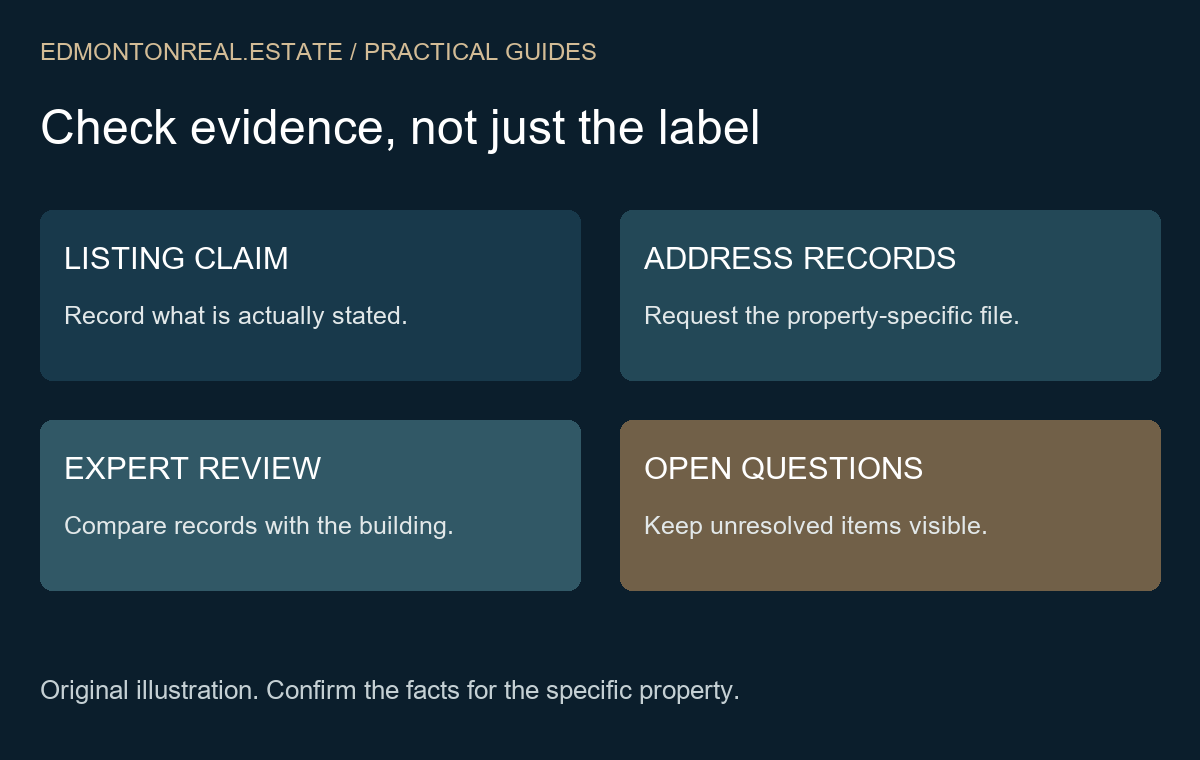
An address-specific evidence checklist for Edmonton secondary suites: distinguish listing claims, municipal records, physical configuration and unresolved questions. This guide is intended as general background—not a substitute for property-specific financial, legal, municipal or professional advice.
A separate entrance, second kitchen or the word suite can prompt useful questions, but it does not supply the approval history. Start a file for the exact address and legal parcel. Record what the listing says, the documents supplied and questions still open. Do not relabel a seller-reported feature as municipally verified because it looks complete in photographs.
The City describes a secondary suite as a separate dwelling within specified forms of housing, with its own living facilities and entrance arrangements. It directs owners to check property zoning and consult the City where needed. That guidance starts an address-specific enquiry; it does not establish the approvals for any property in our search. Other municipalities have their own processes.
Use four columns: the statement being checked; the document or person that can answer; the date and status of the response; and the unresolved question. Record configuration, reported unit count, completed work, available plans and inspection records separately. A large document folder does not establish a completed review. Identify documents referring to another address, a different scope or a proposal.
Ask for available permit identifiers, approved plans, inspection records and a chronology of relevant work. Ask the City which records and status information are available for that address and scope. If consulting a registry or mapping entry, note its date and limitations and reconcile it with the municipal file. Absence from a public search is a reason to ask further questions, not a conclusion by this website about approval.
Inspection and document review answer different questions. Have the appropriate professionals compare the current layout and systems with the records. Keep subsequent changes, missing documents and outstanding conditions visible. Ask who will resolve each item, what evidence is needed and when it will be available. This website does not inspect a property or certify the completeness of a municipal file.
Keep tenancy documents, actual receipts, operating costs and projected rents distinct from the approval review. An asking rent, projected income or furnished-room description does not establish a permitted configuration. Request appropriate documentation for financing and purchase review without publicly circulating tenant-identifying records. Have your advisers assess the property rather than applying a generic return estimate.
Our collection includes explicit seller-reported secondary-suite fields and any separately verified legal-suite flag. Seller-reported results carry a verification reminder. Verified-only searches are narrower and may return no results; the feed does not automatically establish municipal status. General in-suite laundry is not evidence of a secondary suite. Compare the label with your document checklist before drawing a conclusion.
Name the listing or address, explain whether you are buying or selling, and identify the records or questions needing attention. Request a callback to discuss missing information. Keep identification documents, tenant records and bank statements out of a general enquiry form. For Beaumont, Leduc or another community, start with that municipality rather than assuming Edmonton guidance applies.
Sources checked October 23, 2026. Property-specific facts and requirements should be confirmed with the responsible authority.
Marketing a flexible property to both owner-occupiers and investors.
Read the guide ↗