
Questions to Ask Before Leasing an Edmonton Restaurant Space
Compare the proposed restaurant operation, premises records, equipment responsibilities and full opening budget before committing to an Edmonton lease.
Read the guide ↗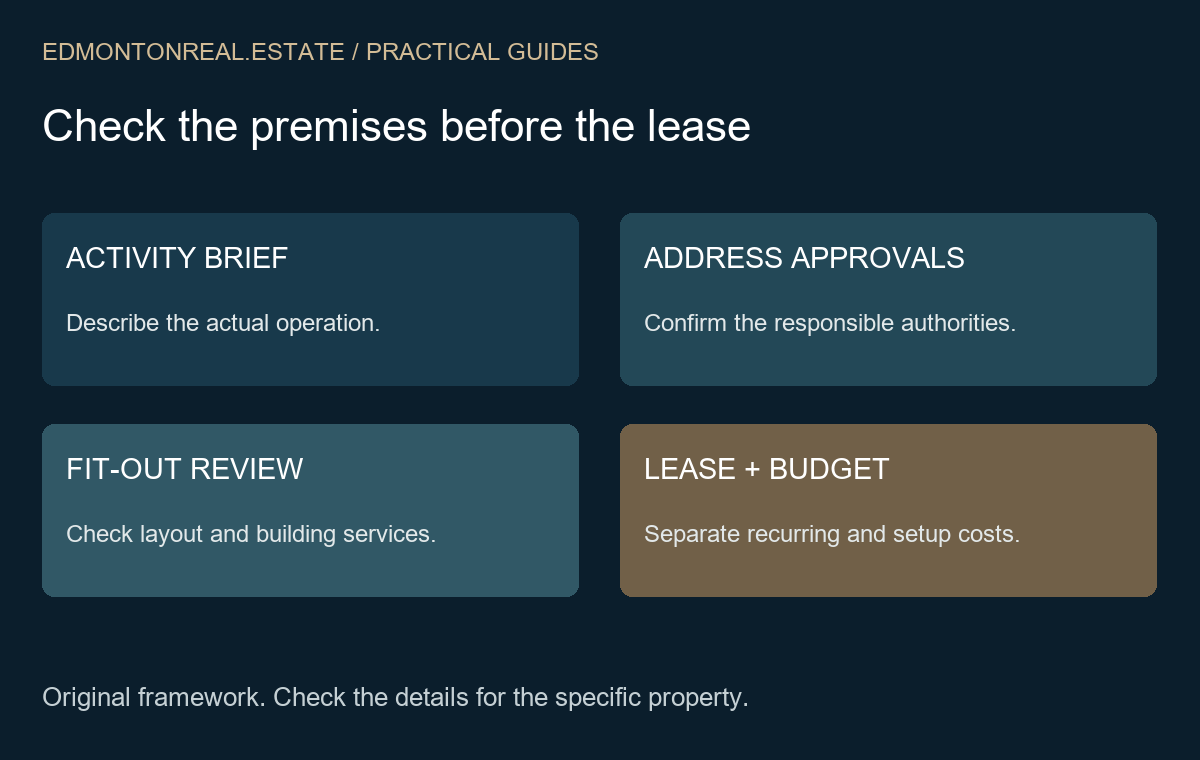
A property-focused checklist for permitted use, client access, room layout, building services, fit-out costs and lease conditions before choosing clinic or spa premises. This guide is intended as general background—not a substitute for property-specific financial, legal, municipal or professional advice.
Clinic, medical aesthetic, wellness and spa are broad descriptions. Prepare a specific list of intended activities, equipment, staffing, opening hours, room needs and expected client arrivals. A consultation office, a personal-service business and a premises offering regulated clinical services may raise different questions. Ask the responsible professional and public-health authorities which requirements apply to your actual activities and practitioners. This guide concerns premises and leasing, not treatment, clinical scope, equipment safety certification or the credentials required to perform a procedure. Keep client and patient information out of the property brief.
Edmonton advises businesses to obtain zoning approval before committing to a lease, or to discuss an appropriately conditional arrangement. The City reviews the proposed activities at the location and identifies whether a development permit is needed. An advertisement saying medical-ready or a former tenant’s use is not a substitute for confirmation of your proposal. Give City staff the exact unit and activity brief. Have your lawyer address approval conditions, deadlines and what happens if the proposed use cannot proceed. Do not assume one landlord permission resolves every municipal or professional requirement.
Start outside the building: wayfinding, arrival, drop-off, parking arrangements, transit and the route to the unit. Then trace reception, waiting, consultation or service rooms, washrooms, staff space, storage and departure. Consider mobility needs and privacy without making assumptions about who will use the business. Ask the designer to evaluate applicable accessibility and building requirements for the proposed work. Test deliveries and waste collection separately from client arrival. A larger unit is not automatically more workable if circulation and support spaces consume the rooms your plan depends on.
Second-generation space may contain rooms or plumbing that appear useful, but obtain plans and ask what was approved, who owns the improvements and what condition they are in. Have your own advisers compare the layout with your intended operation. For shell space, identify the work required before it can be occupied and which party completes it. The City’s existing-building guidance covers tenant improvements, changes in activity, alterations to walls and washrooms, and building-service work. Confirm the actual approval and inspection path rather than assuming an attractive reception area makes the whole unit ready.
Prepare an equipment schedule with the supplier’s installation requirements and ask qualified designers and contractors to assess the premises. Discuss power, ventilation, cooling, plumbing, drainage, structural issues and maintenance access where relevant. Do not specify a universal electrical load, air-change rate or room finish for every clinic or spa. Requirements depend on the activity and design. Identify any landlord work, common-building limitation or approval needed before pricing fit-out. Ask who pays for a service upgrade and who remains responsible for it during the lease and at the end.
Alberta publishes a personal-services regulation and standards resource, including business obligations and notification information. Consult it and the responsible authority for your proposed services. Separately confirm any professional-practice, facility, equipment or other requirements with the regulator responsible for the actual work. A property search label cannot establish that a practitioner may provide a particular service, and a municipal property approval does not grant clinical permission. Keep a checklist naming each authority, the question asked, the evidence received and the unresolved condition rather than relying on one general approved statement.
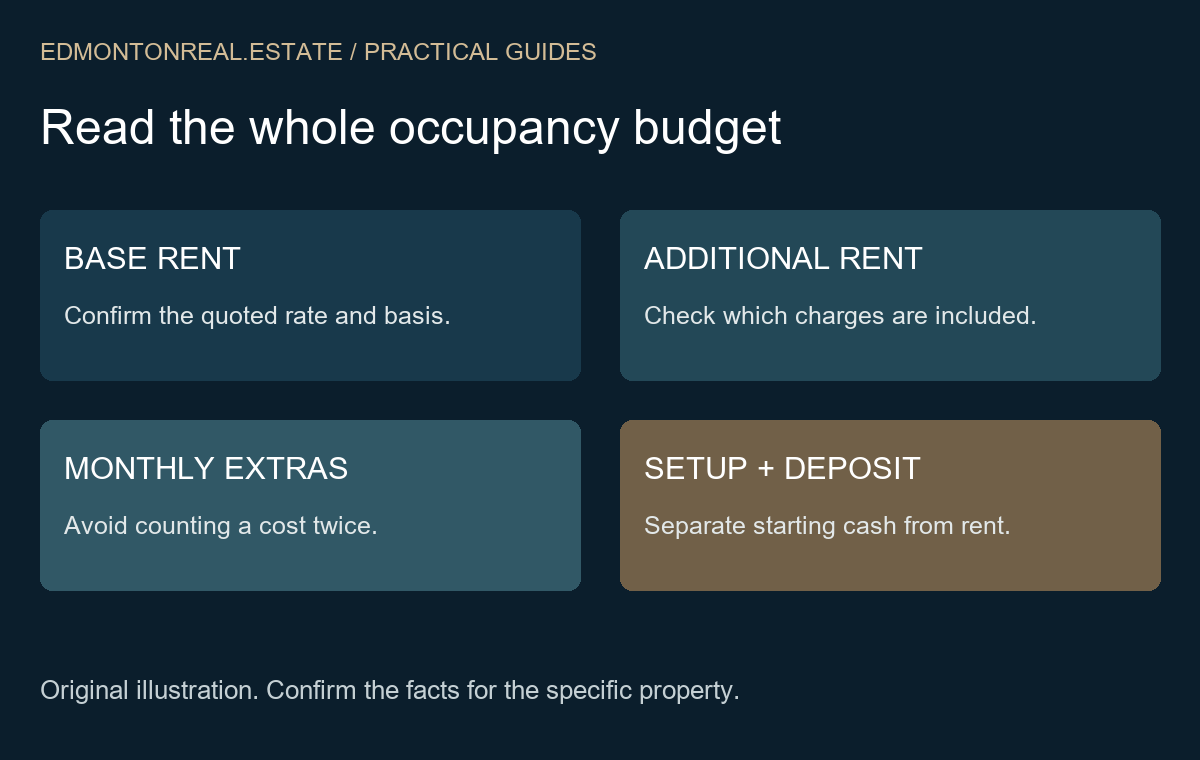
Compare the base rent and its quoted basis, additional rent, separately billed costs, setup work, deposits, professional fees, equipment installation and an appropriate contingency. Keep landlord incentives separate from expenses you must initially fund, and confirm timing and conditions in the written offer. Use our occupancy-cost calculator to convert annual-per-square-foot and monthly quotes into comparable assumptions. It is not a quotation or a forecast of business profitability. If a space has a rate on request, obtain that information rather than treating an unpriced listing as free or excluding it from a useful shortlist.
Have your lawyer review permitted use, exclusivity where relevant, signage, access hours, repairs, HVAC responsibilities, alteration approvals, insurance, assignment, renewal and end-of-lease restoration. Ask how the proposed opening date depends on possession, landlord work, permits, contractor availability and inspections. Identify the cost of delays without assuming a specific opening timeline. A future change of service or ownership can raise fresh questions, so discuss expansion and assignment intentions before treating an inexpensive lease as flexible. Obtain written answers that match the unit and operation you actually plan.
Our commercial rent search includes authorized feed listings; it is not a verified directory of clinic-approved properties. Start with Edmonton or keep a selected community such as Beaumont, compare the available spaces and request the activity-specific checks above. Do not filter out an address solely because its marketing copy lacks a clinic keyword, and do not treat that keyword as proof. Landlords can improve inquiries by supplying accurate area, plans, existing improvements, availability and quoted rent basis while leaving suitability subject to verification. For an established-business purchase, review the premises and lease separately from the confidential business records.
Sources checked October 23, 2026. Property-specific facts and requirements should be confirmed with the responsible authority.
Compare the proposed restaurant operation, premises records, equipment responsibilities and full opening budget before committing to an Edmonton lease.
Read the guide ↗Compare annual-per-square-foot and monthly lease quotes, separate recurring costs from opening cash, and use an editable occupancy-cost calculator.
Read the guide ↗Attract a better-fit tenant with clearer occupancy information and useful visuals.
Read the guide ↗