
How to Evaluate an Established Business for Sale
Questions buyers should ask about revenue quality, operations, staff and leases.
Read the guide ↗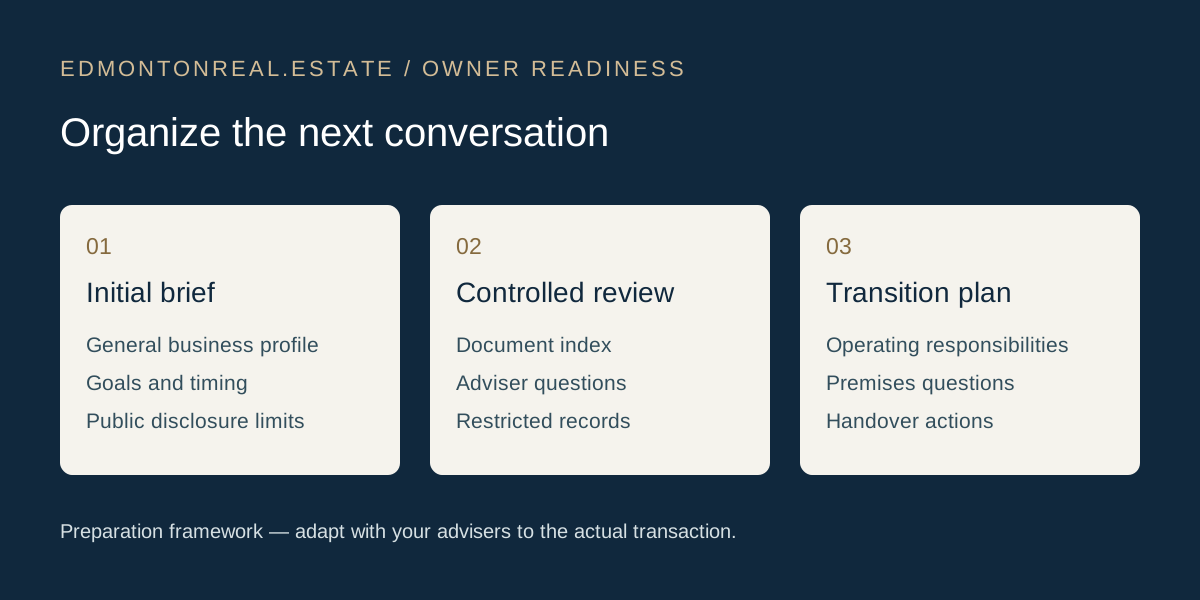
A practical readiness checklist for Edmonton business owners with $500K+ annual revenue: organize records, separate premises questions and release information in stages. This guide is intended as general background—not a substitute for property-specific financial, legal, municipal or professional advice.
For an Edmonton owner considering a sale, start with the result you want: retirement, a staged handover, time for another project or continued involvement on agreed terms. Write down your timing, what must keep operating during the process and who is authorized to discuss a potential transaction. Our $500K+ annual-revenue focus describes the established-business audience. It does not mean the business is worth $500,000, that it will sell at a particular price or that a buyer is already available.
Create a short working brief covering the sector, general location, broad revenue range, owner involvement, premises arrangement and preferred transition. Decide with your advisers which facts can appear publicly and which should remain restricted. Even a combination of non-identifying details can reveal a distinctive business. Review the brief as a whole before authorizing publication. Keep customer lists, staff information, account details and private financial statements out of the website inquiry form; use an agreed controlled process for later disclosure.
Use a simple tracker with six columns: item, period or address covered, person responsible, status, unresolved question and next action. Begin with financial records, equipment and inventory, contracts, premises documents and operating procedures. Use plain status labels such as requested, received and reviewed; receiving a file does not mean its contents have been verified. BDC recommends early preparation with appropriate advisers, including review of financial information, operating dependencies and agreements. Your tracker turns those broad workstreams into an actionable preparation list without circulating the underlying confidential files.
Ask your accountant which historical and current records are appropriate for the proposed transaction. Keep recorded results, explanations of unusual items and forward-looking assumptions clearly separated. Mark the period and source beside each number so a buyer does not compare a full year with an incomplete period. Do not turn annual revenue into a valuation multiple or describe an owner adjustment as accepted simply because it appears in a spreadsheet. Leave valuation, tax treatment and proposed transaction structure to the advisers reviewing the actual business.
Record whether the operation leases space, owns the premises or depends on another occupancy arrangement. Ask the appropriate adviser to identify lease term, renewal options, assignment or consent questions, included equipment, maintenance responsibilities and unresolved occupancy issues from the actual documents. In Edmonton, the City says starting a business, moving location or changing business activities requires zoning approval. It encourages resolving zoning before a lease commitment. That guidance is not a conclusion about an existing operation or the transfer of its approvals: ask the City what the proposed ownership, activity or premises changes require. Outside Edmonton, start with the municipality responsible for the address.
Map a typical working week and identify decisions, relationships or tasks that depend on you personally. For each dependency, note who could take responsibility, what instructions exist and what remains to be taught. Consider customer service routines, supplier ordering, equipment servicing, system access and key renewal dates. This is a preparation exercise, not a promise that staff, contracts or approvals will transfer. Use a staged handover discussion to identify gaps early instead of presenting owner independence as an untested selling claim.
An original planning example: an Edmonton service-business owner prepares a general opportunity brief first, then organizes a restricted document index for an adviser-led review, and finally creates a transition responsibility list. The document index names records and outstanding questions; it does not contain customer or employee data. Any later disclosure follows the seller-authorized confidentiality and professional process agreed for the transaction. This hypothetical sequence is a way to organize work, not a prescribed legal process or evidence that a confidentiality agreement removes every disclosure risk.
Bring a general business description, approximate annual-revenue range, leased-versus-owned premises, desired timing and the questions you want help organizing. Explain whether the business and any real estate would be considered together or separately, without treating that initial preference as a decided legal structure. Our business opportunities search is a discovery tool, not a complete list of confidential Edmonton transactions. Request a callback about your preparation plan; share sensitive supporting records only through an appropriate process agreed with your advisers.
Sources checked October 23, 2026. Property-specific facts and requirements should be confirmed with the responsible authority.
Questions buyers should ask about revenue quality, operations, staff and leases.
Read the guide ↗Learn which high-level facts help narrow your search before confidential disclosure.
Read the guide ↗